

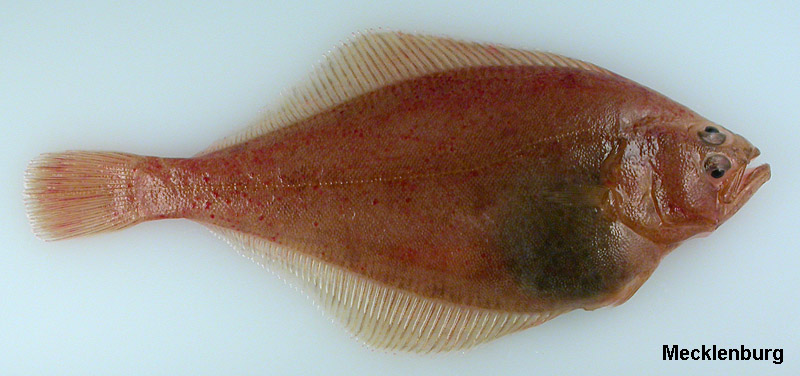






Bering Flounder: Hippoglossoides robustus Gill & Townsend, 1897
An abundant flounder in the Chukchi Sea, less common but widespread in the Beaufort Sea
Size
- 52 cm reported
- Reaches half this size in Chukchi and Beaufort seas
Color & Characteristics
- Eyed side reddish brown, blind side off-white
- Lateral line slightly curved above pectoral fin
- Lower jaw with symphyseal (at the midline) knob and pointed mandibular articulation (at back of the lower jaw)
- Sympatric with flathead sole, H. elassodon, in Bering Sea
- Gill rakers on lower limb of 1st arch in H. robustus usually < 13 (vs. > 14 in H. elassodon), total on both limbs usually < 17 (vs. > 19)
Habitat
- Arctic-boreal Pacific
- Benthic, most abundant on mud
- Intertidal depths to 532 m, usually < 150 m
- Near-bottom temperatures of –1.8 to 7.9°C (Chukchi Sea)
Feeding
- Preys on pricklebacks, eelpouts, poachers, sculpins, and cods, and amphipods, shrimps, crabs, and other small bottom invertebrates
- Eaten by cods, halibuts, seals, beluga whales
Life cycle
- Spawns in shallow bays and gulfs in April to June
- Egg diameter 2.0-2.7 mm
- Eggs and larvae pelagic
- Females with ripe eggs were 25–29 cm long in Avachinskaya Bay (southeastern Kamachatka) in mid-May
- Adults attain at least 13 years of age
- Takes 11 years to reach 23 cm
Page Author: CW Mecklenburg & TA Mecklenburg
Updated: March 5, 2011
